London Marathon Training Plan — And Every Abbott World Marathon Major
- May 20
- 20 min read
By Andy Hood — Ultra Runner, Cancer Survivor, Runna Ambassador | RunningWestwardHo.co.uk
Before we dive in, as a Runna Ambassador I have an exclusive code that gives you a full 2-week free trial of Runna (double the standard 7-day trial). Use code ANDY2 or click here to redeem. More on why I rate Runna so highly throughout this article.
I'll be honest with you. Before my cancer diagnosis in 2021, I was a fairly casual marathon runner. A 3:45 finish, nothing to shout about, ticking along. Then surgery and chemotherapy took my running shoes away for months, and when I laced them back up again, something had shifted. I didn't just want to run, I needed to run with purpose.
That journey took me from a comeback 170-mile run along the South West Coast Path to Land's End, to twice completing the 160km Tour du Mont Blanc through France, Switzerland and Italy, to ultras across London, the Surrey Hills and beyond. Along the way my marathon PB dropped to around 3:20, and a lot of that is down to finally understanding how to train properly, not just log miles, but train smart. If you're newer to the distance, my complete guide to training for your first marathon covers the fundamentals from scratch.
One of the most important decisions I made was to stop following generic plans lifted from websites and start using Runna, a personalised coaching app that builds your plan around your goal race, your current fitness and your real-life schedule. I've been using it for over three years, and it's one of the reasons I'm a proud Runna Ambassador today.
This article is primarily a London Marathon training plan, because London is where most UK runners' Major ambitions begin, and because over a million people applied for the 2026 race, meaning if you have a place, it's genuinely precious. But it doesn't stop there. Whether you're training for London, chasing a Berlin PB, navigating New York's five boroughs or working your way toward the Six Star Finisher Medal, this guide covers what you actually need to train well for all seven of the Abbott World Marathon Majors.

Contents
What Are the Abbott World Marathon Majors?
The TCS London Marathon is one of seven races that make up the Abbott World Marathon Majors (AbbottWMM), widely regarded as the most prestigious series in mass participation running. The full seven are Tokyo, Boston, London, Sydney, Berlin, Chicago and New York City. Sydney joined the series in late 2024 as the seventh member, with the eventual goal of a Nine Star Finisher Medal on the horizon as Cape Town and Shanghai go through the candidacy process.
Completing all seven (or the original six) earns you the coveted Six Star Finisher Medal, widely considered marathon running's Holy Grail. But even running just one of these races is a serious achievement. Entry is harder than ever. London is the hardest ballot in the world, over one million people applied for the 2026 race, with a success rate of under 2%. Tokyo's international acceptance rate sits around 8–10%. New York's acceptance rate has collapsed from 12% in 2022 to around 2–3% today. Berlin and Chicago remain the most accessible via ballot, but even they're seeing fields of 40,000–50,000 runners.
For a detailed breakdown of all seven races including entry routes, ballot odds and course overviews, see my Abbott World Marathon Majors complete guide.
If you've been lucky enough to get a place in any of these seven races, and especially if London is your race, you owe it to yourself, and to however many years of ballot rejections got you here, to arrive on the start line properly prepared.
That's what this guide is for.

Why Generic London Marathon Training Plans Fall Short
Here's something the generic plans on big running websites won't tell you: the marathon you're running matters enormously to how you should train, and a London Marathon training plan that doesn't account for London's specific course, conditions and race-day dynamics is just a generic plan with a different header.
A 16-week plan downloaded from a running aggregator site is built around an average runner, an average race, average conditions. The World Majors are anything but average. Each has a distinct course profile, a distinct weather window, a distinct crowd dynamic, and a distinct set of psychological challenges that will test you in ways a spreadsheet plan can't anticipate.
When I brought my marathon PB down from 3:45 to 3:20 after cancer, it wasn't because I ran more miles. It was because I trained specifically, understanding what each training phase was for, what each run was building, and how to arrive at a start line feeling sharp rather than just surviving to race day.
The good news is that the core principles of marathon training apply across all seven Majors. The training framework I'm going to walk you through works for all of them. What changes is how you apply it, and that's where the race-specific sections below, and a personalised plan through Runna, make the real difference.
The London Marathon Training Plan Framework — And How It Applies to Every Major
How Long Do You Need?
For a London Marathon training plan, and for any World Major, 16–20 weeks is the sweet spot. First-timers and those returning from injury or a long training gap should aim for 18–20 weeks. Experienced runners with a solid base and recent half-marathon fitness can work well with 16 weeks. If you haven't yet completed a half marathon, I'd recommend building to that distance first, my complete guide to training for your first half marathon gives you a clear pathway. The key is having enough time to build gradually, never increasing weekly mileage by more than 10% week on week, and to peak properly before a 2–3 week taper.
The Four Phases
Phase 1 — Base (Weeks 1–5): This is about building the aerobic engine. Easy runs, a weekly long run that starts conservatively, light strength work. You're not trying to prove fitness here; you're building the foundation everything else sits on. The majority of your running should feel genuinely easy, conversational pace, where you could hold a chat without gasping. If your long run leaves you wiped out for two days, you went too hard.

Phase 2 — Build (Weeks 6–11): Now you start layering in quality. Tempo runs, marathon-pace segments within your long runs, and some interval work. Your long run grows steadily but crucially starts to include stretches at or near your goal marathon pace, teaching your body to run fast on tired legs, which is the whole game in a marathon. This is where a good plan earns its money.
Phase 3 — Peak (Weeks 12–14): Your highest mileage weeks. The long run hits its maximum, typically 20–22 miles for those chasing a time goal, slightly less for first-timers focused on finishing. Race-specific workouts are the priority. For a Major, this is also where you should be rehearsing your nutrition strategy: practising gels, hydration and fuelling on long runs exactly as you plan to do on race day. Never experiment on race day with anything you haven't trained with.
Phase 4 — Taper (Weeks 15–16/17–18): The most underrated and most anxiety-inducing phase of any training cycle. Volume drops by roughly 20–40% but intensity is maintained. The taper is not the time to cram in missed miles. Your fitness is banked; what you're doing now is shedding accumulated fatigue so you arrive on the start line feeling sharp. Almost every runner I speak to struggles with the taper, the legs feel heavy, doubt creeps in, the urge to do one more long run is overwhelming. Resist it.
The Three Types of Runs That Actually Matter
Every successful marathon training block, regardless of the plan you follow, is built on three run types:
Easy runs are the backbone. They should genuinely feel easy, Zone 2 effort, conversational pace. The vast majority of your weekly mileage sits here. These runs build your aerobic base, support recovery between harder sessions and accumulate the time-on-feet that underpins everything else. If you're unsure what Zone 2 actually feels like in practice, I've written a detailed guide on Zone 2 running — the science, benefits and how to do it.
The long run is your weekly centrepiece. It's where you build endurance, practice fuelling, develop mental toughness and simulate the psychological experience of being on your feet for race-relevant durations. As your build phase progresses, quality long runs will include segments at marathon pace, not easy shuffles.
Quality sessions — tempo runs, interval work, marathon-pace blocks, are where you get faster. These sessions are stressful and require proper recovery. One or two per week is enough for most runners. More is not better; more leads to breakdown. To calculate your target paces for each session type, use my running pace calculator, it takes your goal time and works out the exact paces you should be hitting in training.
Strength Training: The Most Skipped Part of Marathon Prep
I've learned this the hard way across multiple training cycles. Strength work is not optional for marathon runners, it's injury prevention, it's running economy improvement, and it's the difference between finishing strong and limping through the final six miles.
Two sessions per week of runner-specific strength training, focusing on glutes, hips, single-leg stability and calf strength, is enough to make a significant difference. Reduce lower body volume in the final two weeks before race day, but don't drop it entirely.
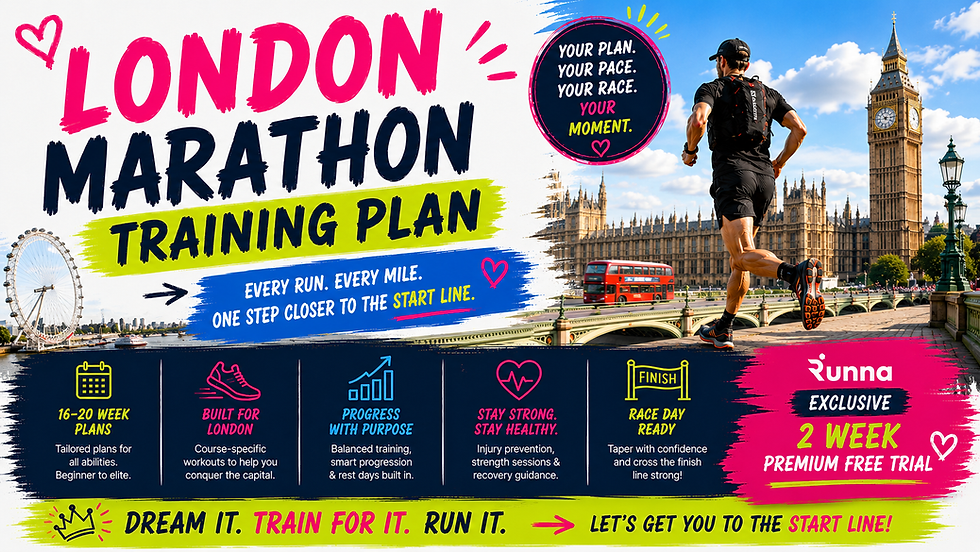
🎯 Train With a Plan Built for YOUR Race
Before we get into the race-by-race breakdowns, this is the right moment to mention Runna, because this is exactly where a personalised plan beats a generic one.
When you set up a Runna plan, you tell it your goal race, your target time, your current weekly mileage, how many days you can train and what your schedule looks like. It builds you a complete, progressive plan around all of that, not around an imaginary average runner. It includes guided workouts, real-time audio coaching, strength sessions, and it adapts if you miss days or your fitness changes.
As a Runna Ambassador, I can offer you an exclusive 2-week free trial, double the standard 7-day trial new users normally get.
👉 Use code ANDY2 or click here — no payment details required to start
The trial gives you full access to everything, including your personalised London marathon plan. Use the two weeks to get a feel for the sessions, the pacing guidance and the platform before deciding if it's right for you. I've been a paying subscriber for over three years, so I'll let that speak for itself.
The Seven Majors: Race-by-Race Training Guide
🇬🇧 TCS London Marathon — April ⭐ Primary Focus
The race: For most UK runners, London is the dream race, and with good reason. The course runs from Greenwich through the City, down to Canary Wharf and the Isle of Dogs, then back along the Embankment to the iconic finish on The Mall. It's net flat with negligible elevation gain, making it a genuine PB course. The crowds are relentless in the best possible way, lining every single kilometre from Greenwich to the finish, and the atmosphere in late April is unlike anything else in British sport.
Entry: The hardest ballot in the world at around a 2% success rate for general entries. Over one million people applied for the 2026 race. Charity places, Good for Age entries and overseas entries through travel operators all offer alternative routes in. If you have a place, treat it with the respect it deserves.
London Marathon training plan — key focus: London's flat course means there is nowhere to hide from poor pacing, poor fuelling or poor preparation. The course rewards even splits, if you run the second half faster than the first, you've had a perfect day. The most common mistake is letting the extraordinary atmosphere pull you out too fast in the early miles through Blackheath, Greenwich and Bermondsey. The first 10km should feel embarrassingly easy. Miles 18–22 through Canary Wharf and back are where races are decided, if you've respected the early miles, you'll be passing people here. If you went out too hard, you'll be the one getting passed.
The key race-specific workouts for a London Marathon training plan are marathon-pace runs built into your long runs from around week 8 onwards, and a well-rehearsed nutrition strategy. By the time you hit Cutty Sark at mile 6, you should already have taken on your first gel. Practise this on every long run.
Key training consideration for London: Late April in London is typically mild and cool, ideal running conditions. But the sheer scale of the event (50,000+ runners) means race-day logistics matter almost as much as fitness. You'll be standing in a start village for 60–90 minutes before your corral is called. Practise your pre-race nutrition around this reality, not around a 9am gun. Carry a throwaway layer for the start village and eat a small second breakfast while you wait.
🇯🇵 Tokyo Marathon — March
The race: Tokyo is one of the most organised and atmospherically unique marathons in the world. The course runs through the heart of the city, largely flat with a net downhill tendency. Weather in early March is typically cool (3–10°C at the start), making it a genuinely fast course for those who execute well.
Entry: The hardest Major to crack for international runners. With roughly 300,000 entries for 37,000 spots, and international runners facing considerably steeper odds than domestic applicants, getting a Tokyo place via ballot is a serious achievement. Charity and travel operator entries exist but come at a cost.
Training focus: The flat, fast course rewards even pacing and rewards runners who have done their marathon-pace work. The cool conditions mean you can be ambitious with your time target. The main trap is the atmosphere, Tokyo's crowds are extraordinary and incredibly respectful; it's easy to go out slightly too fast in the early kilometres. Train yourself to run conservatively for the first 10km.
Key training consideration: Tokyo's March date means your peak training block falls in January and February. If you're based in the UK or northern Europe, that means cold, dark early-morning runs and potentially disrupted long runs around Christmas. Factor this into your planning, it's exactly the scenario where a structured Runna plan keeps you accountable when motivation wavers.
🇺🇸 Boston Marathon — April
The race: Boston is unlike any other Major, it's a qualifier, not a ballot race, which means everyone around you has earned their place with a previous fast time. The course is point-to-point from Hopkinton to Boston and famous for its Newton Hills, a series of climbs in miles 16–21 that have ended many a well-laid race plan. Heartbreak Hill at mile 20 is the most famous, but it's really the accumulation of climbs after 15 miles of running that tests you.
Entry: Qualification time standards apply based on age and gender, making Boston accessible to fast runners regardless of ballot luck. If you're chasing a BQ (Boston Qualifier), your entire training cycle should be structured around running a fast time at a qualifier race first.
Training focus: You must train on hills. Not just one hill session per week, your long runs should include meaningful elevation, and you should specifically prepare your quads for the downhill miles in the first half of the course, which cause enormous eccentric muscle damage if you haven't trained for them. Include deliberate downhill running in your build phase. Arrive with fresh, strong quads, not ones that have been destroyed by overly hard early miles.
Key training consideration: April in New England can be anything, hot sun, freezing rain, headwinds. The 2018 race was run in near-freezing rain and 30mph headwinds. The 2012 race was run in 26°C heat. Your race plan needs a hot-weather version and a cold-weather version, and your nutrition strategy needs to be robust enough to handle either. If you're building toward Boston via a European qualifier, my guide to the best European marathons in 2026 has some excellent flat, fast options worth considering.

🇦🇺 TCS Sydney Marathon — August/September
The race: Sydney is the newest of the Majors, having joined the series in 2024, and it's quickly established itself as one of the most exciting entries on the calendar. The course takes in the Sydney Harbour Bridge and Opera House, genuinely iconic scenery, before heading through the Royal Botanic Garden and finishing in the CBD. It's a more undulating course than London or Berlin, and the August/September timing means late winter in the southern hemisphere, cool and generally good running conditions.
Entry: Currently the most accessible of the Majors via ballot. Over 123,000 people entered the ballot for the 2026 race, making it the world's fastest-growing marathon, but with a field of around 20,000, the odds are considerably better than any of the other six. If you're chasing your first Major, Sydney is the one to target.
Training focus: The undulating course requires a different approach from London or Berlin. You need hill training, not just for the ascents but for the quad-hammering descents. Build this into your long runs from the build phase onwards. Sydney's crowds are phenomenal and the scenery through the harbour is unlike anything else in Major running; enjoy it, but don't let the spectacle distract you from your pacing.
Key training consideration: For northern hemisphere runners, an August/September race means a peak training block in June and July. Summer heat training adds an extra variable, run your easy miles early in the morning or late evening, and take your long runs seriously in terms of hydration. You may well race in cooler conditions than you train in, which is generally an advantage.
🇩🇪 BMW Berlin Marathon — September
The race: Berlin is the world's fastest marathon course. The majority of the men's and women's marathon world records have been set here, and it's not a coincidence. The course is almost completely flat, passing through the iconic Brandenburg Gate in the final kilometre, and September conditions in Berlin are typically cool and dry. If running a marathon PB is your goal, Berlin is the race to target.
Entry: One of the more accessible Majors, with a ballot success rate of around 13–14%. The field size is large, which helps.
Training focus: On a course this fast, race execution matters enormously. The temptation is to go out at a pace that feels comfortable given how flat the course is, and then discover at mile 20 that comfortable in the first half was not sustainable. Your marathon-pace training needs to be dialled in precisely, and your goal time should be based on recent tune-up races, not optimism.
Berlin also rewards runners who have done their long runs properly. The last 10km of Berlin are where well-prepared runners extend their time on the way to a PB, and where underprepared runners discover the wall.
Key training consideration: A September race means peak training in July and August, the hottest months for UK-based runners. Use those hot training runs to build mental toughness but don't use them to judge fitness; heat significantly impacts pace. Do one or two tune-up races (a half marathon in July or August is ideal) to benchmark your fitness in race conditions.
🇺🇸 Bank of America Chicago Marathon — October
The race: Chicago is flat, fast, extraordinarily well-organised and arguably the best crowd atmosphere of any Major outside London. The course loops through the city's diverse neighbourhoods, from downtown to Chinatown to Lincoln Park, providing constant distraction and support. It's a legitimate PB course.
Entry: The most accessible of the American Majors via ballot, with a success rate of 17–25% depending on the year. Chicago accepts around 45,000 runners from 100,000+ applicants.
Training focus: Chicago in October can be hot. The 2007 race was cancelled partway through due to extreme heat. Even in a normal year, October temperatures in Chicago can be significantly warmer than UK running conditions, and heat management, slower early pace, aggressive hydration, adjusted time expectations, is part of race preparation, not an afterthought.
Your peak training in July and August will feel hot, which is actually useful conditioning for a warm race day. Don't abandon your goal pace training, but build in a warm-weather contingency plan.
Key training consideration: The Chicago course has virtually no elevation change, which means quadricep fatigue rather than incline fatigue becomes the issue late in the race. Ensure your training includes proper marathon-pace miles in the later stages of long runs, teaching your legs to run efficiently when already fatigued on flat ground.
🇺🇸 TCS New York City Marathon — November
The race: New York is an experience unlike any other race in the world. The five-borough course, Staten Island, Brooklyn, Queens, the Bronx, Manhattan, crosses five bridges, and each borough brings its own crowd character. Thousands of spectators line every mile, and the noise on the Queensboro Bridge approach and in Central Park for the final miles is something no race report can adequately capture.
But New York is also a hard course. The Verrazzano-Narrows Bridge in mile one is a significant climb right at the start. The rolling nature of the course, with constant small changes in elevation across five bridges, takes more out of you than a flat course at the same pace. Runners who have trained purely on flat terrain often find New York more punishing than expected.
Entry: Acceptance rates have dropped sharply, from 12% in 2022 to around 2–3% by 2025. Charity entries, 9+1 volunteer programme places and travel operator entries are alternative routes.
Training focus: Include regular rolling terrain in your long runs. You don't need mountains, but you need your legs accustomed to repeated small undulations over distance. The bridges themselves are brief but come at the worst moments, miles 1, 13, 15, 23, and training to maintain effort (not pace) over short inclines is the specific skill to develop.
New York is also a November race, which means cold conditions are likely. Race in layers you can shed, and practise running in cold conditions during your October peak training.
Key training consideration: The late November date makes New York the natural endpoint of a year of marathon building. If you're doing a spring race and hoping to do New York in the same year, be careful with recovery. A September Berlin followed by November New York is possible but requires experienced management of the recovery block between them, not something to improvise.

Building Your Personalised Plan Around Your Race
The section above gives you the race intelligence. What it can't do is build you a week-by-week training schedule tailored to where you are right now, how much time you have until race day, how many days you can train, and what your goal time is.
That's exactly what Runna does.
I started using Runna after cancer because I needed something that would adapt as I rebuilt fitness, a plan that would push me without breaking me, and that would flex when life got in the way. Three years and a marathon PB later, I'm still using it and still learning from it. I've also written a detailed comparison of Hal Higdon vs Nike Run Club vs ChatGPT vs Runna if you want to weigh up your options before committing.

Here's what the 2-week free trial gives you access to:
A personalised plan built around your specific race and goal time
Guided workouts with real-time audio coaching for every session
Integration with Garmin, Apple Watch, Coros and Suunto
Strength and conditioning sessions designed specifically for runners
A plan that adapts week by week as you sync your runs
The standard Runna trial is 7 days. My ambassador code doubles that to a full two weeks, enough time to run a long run, a tempo session, an interval session and see exactly how the app coaches you through each one.
👉 Use code ANDY2 at
2 weeks free, no payment needed to start
The Things Nobody Tells You About Race Day at a Major
I've run enough events and spoken to enough runners at the World Majors level to know there are a handful of things the training articles never cover.
The start village is part of the race. At London, New York and Chicago you'll be standing in a holding area for 60–90 minutes before your wave is called. That means being on your feet, potentially in the cold, burning energy before you've even run a metre. Carry a throwaway layer, eat a small second breakfast in the village, and stay off your feet as much as possible.
The early miles will feel too easy. At every Major, the combination of crowds, adrenaline and fresh legs makes your goal pace feel effortless in the first 5km. This is a trap. The miles you bank here are borrowed from miles 18–22. Run to feel, not to pace, and keep that feeling genuinely conservative for the first quarter.
Fuelling starts earlier than you think. By the time you feel like you need a gel, you're already behind. For races of 3:30 and above, start taking on energy from around 45 minutes in and continue at regular intervals throughout. Your long runs in training should rehearse this exactly. I usually take on gels from 20-30 minutes, but that's what works for me after years of practice.
The wall is real, but it's not inevitable. It's largely a nutrition and pacing problem. Train your fuelling, respect the early miles, and the wall becomes a manageable dip rather than a collapse.
The final miles are yours. If you've trained well, paced honestly and fuelled properly, the last 5km of a World Major are among the most extraordinary experiences in running. The crowd at New York's Central Park, the Brandenburg Gate in Berlin, the Mall in London, these are moments you've earned. Slow down and take them in. And if completing a Major leaves you wondering what comes next, the lessons of ultra marathon training might surprise you with how naturally they build on marathon foundations.
Start Your London Marathon Training Plan Today — or Get Ready for Any Major
Whether you're preparing a London Marathon training plan for an April start line or targeting Berlin, Chicago or New York later in the year, the fundamentals in this guide apply to all of them. What changes is the race-specific execution, and that's where a personalised plan built around your exact race makes all the difference.
I've been on both sides of good and bad marathon preparation. The difference is enormous, not just in the finish time, but in how the whole experience feels.
If you're serious about your next Major, I genuinely recommend starting your plan with Runna. The two-week free trial with my ambassador code gives you everything you need to experience the platform properly before committing.
👉 Claim your 2-week free trial: use code ANDY2 at
See you at a start line.

Frequently Asked Questions
How long should a London Marathon training plan be? For most runners, 16–20 weeks is the recommended range. First-time marathoners or those returning from injury should allow 18–20 weeks to build mileage safely. Experienced runners with a recent half-marathon base can work with 16 weeks. The official London Marathon training plans are 16 weeks, which suits improvers well, but beginners often benefit from starting earlier.
When should I start training for the London Marathon? The London Marathon typically takes place in late April. Working back 16 weeks puts your start date in early January. If you're a first-timer or building from a low base, starting in October–November gives you 20–24 weeks and a much more gradual build. Never start a marathon training plan without being able to comfortably run 3–4 miles continuously.
How many days a week should I run in marathon training? Most marathon training plans run on 4–5 days per week. This includes one long run, one or two quality sessions (tempo or intervals), and two to three easy runs. Running more than five days is fine for experienced runners but adds injury risk for beginners. Consistency across the weeks matters far more than daily volume.
What is the hardest Abbott World Marathon Major to get into? London is the hardest by ballot, with around a 2% acceptance rate from over one million applicants for the 2026 race. New York City has also become extremely competitive, dropping to around 2–3% acceptance. Tokyo is notoriously difficult for international runners. Berlin and Chicago remain the most accessible, with ballot success rates of roughly 13–14% and 17–25% respectively. Sydney, as the newest Major, currently offers the best odds.
Can I use the same training plan for every World Marathon Major? The core training framework, base, build, peak, taper, applies to all seven Majors. What changes is how you apply it: Boston requires hill training and quad preparation for descents; New York needs rolling terrain work; Chicago and Berlin reward precise marathon-pace training; London's flat course demands disciplined early pacing. A personalised plan like Runna builds these race-specific elements in automatically.
What is a realistic first London Marathon finish time? The average London Marathon finish time is around 4:45–5:00 for first-timers. Runners with a solid half-marathon base and 16–20 weeks of structured training can reasonably target 4:00–4:30. Sub-4:00 is achievable for runners who have run a half marathon under 1:55 and can commit to 4–5 training days per week. A running pace calculator can help you set realistic targets based on your current fitness.
Is Runna good for London Marathon training? Yes, Runna builds a personalised plan specific to your goal race (including London), your target finish time, current weekly mileage and available training days. It includes guided workouts, real-time audio coaching, strength sessions and watch integration. The standard trial is 7 days; using ambassador code ANDY2 gives you a full 2-week free trial. I've used it personally for over three years and brought my marathon PB from 3:45 to 3:20 in that time.
How do I get a place in the London Marathon? The main routes are: the general ballot (opens after each year's race, results in October), a Good for Age entry if you've run a qualifying time at another marathon, a charity place (raising a minimum sponsorship amount for a partner charity), or an overseas entry through an official travel operator. Good for Age standards for 2026 range from sub-3:05 for men aged 18–40 to sub-5:30 for women aged 70+. The ballot is the most common route but with a 2% success rate, having a backup plan is wise.
What's the difference between training for London and training for Berlin? Both are flat, fast courses, but Berlin in September means your peak training falls in July and August, hot months that require early-morning long runs and adjusted pacing. London in April means a winter training block (January–March) which brings its own motivational challenges. Berlin is generally regarded as the faster course for a PB attempt given the typically cooler September conditions; London's electric atmosphere can push you to go out too fast if you're not disciplined.
I've just finished Couch to 5K — is a marathon realistic? A marathon is realistic but not immediately. The smart progression is 5K → 10K → half marathon → marathon, with several months between each step. My guide on what to do after Couch to 5K maps out this journey in detail. Rushing to the marathon without the intermediate steps significantly increases injury risk and makes the experience much harder than it needs to be.
Disclosure: I am a Runna Ambassador and receive benefits from Runna in connection with this partnership. All opinions are my own, based on three-plus years of personal use.
Comments