How to Train for Your First 50K: Why the Same Plan Can't Prepare You for Two Different Races
Updated: May 31
From a runner who's gone from a half marathon to ultras all over the world, and learned the hard way that a printed plan only gets you so far.
There's a moment that catches almost everyone the first time they go looking for a 50K training plan. You search, you find a tidy grid (Week 1, Monday rest, Tuesday intervals, Saturday long run), you print it, stick it on the fridge, and feel ready. I did exactly that for my first ultra. And here's the honest truth: those plans aren't useless. A good printed plan is a perfectly sensible place to start. It gives you structure, it stops you doing too much too soon, and it gets thousands of people across their first finish line every year.
But there's a ceiling to what a one-size-fits-all plan can do. And the cleanest way to show you that ceiling is to tell you about two 50Ks I've run, the same distance on paper, two completely different animals in reality.
If you've already conquered your first half marathon and your first marathon, the 50K is the natural next rung on the ladder. Let me help you climb it properly.
What's in this guide
First things first: a 50K is not "a marathon plus a bit"
This is the misconception that catches marathon runners out. A 50K is 31 miles, only about five miles longer than a marathon, so the logic goes that you just tack a bit onto your marathon training and you're sorted.
It doesn't work like that, and here's why. A marathon is a performance event: you can push uncomfortably hard, blow up, and still grind your way to the line. An ultra asks for something different. Most 50Ks are run on trails, which means hills, uneven ground, mud, gates, and terrain that constantly changes your pace and effort whether you like it or not. You're on your feet far longer. You have to eat and drink while moving in a way a marathon never demands. And the mindset shifts from "how fast can I go" to "how well can I keep going."
Before you start any 50K block, you want a genuine base behind you: ideally several months of consistent running, the ability to run comfortably for a couple of hours, and, preferably, a marathon or a long trail race already in the legs. You don't strictly need all of that, but you'll have a far better time if you do.
Two 50Ks, one distance, and why that changes everything
The rolling one: North Downs 50
The Ultra Challenge North Downs 50 is a looped 50km out of a Guildford basecamp, taking in the chalk ridges and ancient woodland of the Surrey Hills (St Martha's Hill, Newlands Corner, proper English countryside with grand views out to the south). It's rolling rather than mountainous: there are climbs, but nothing that stops you in your tracks, and the event is superbly supported with stocked rest stops the whole way round.
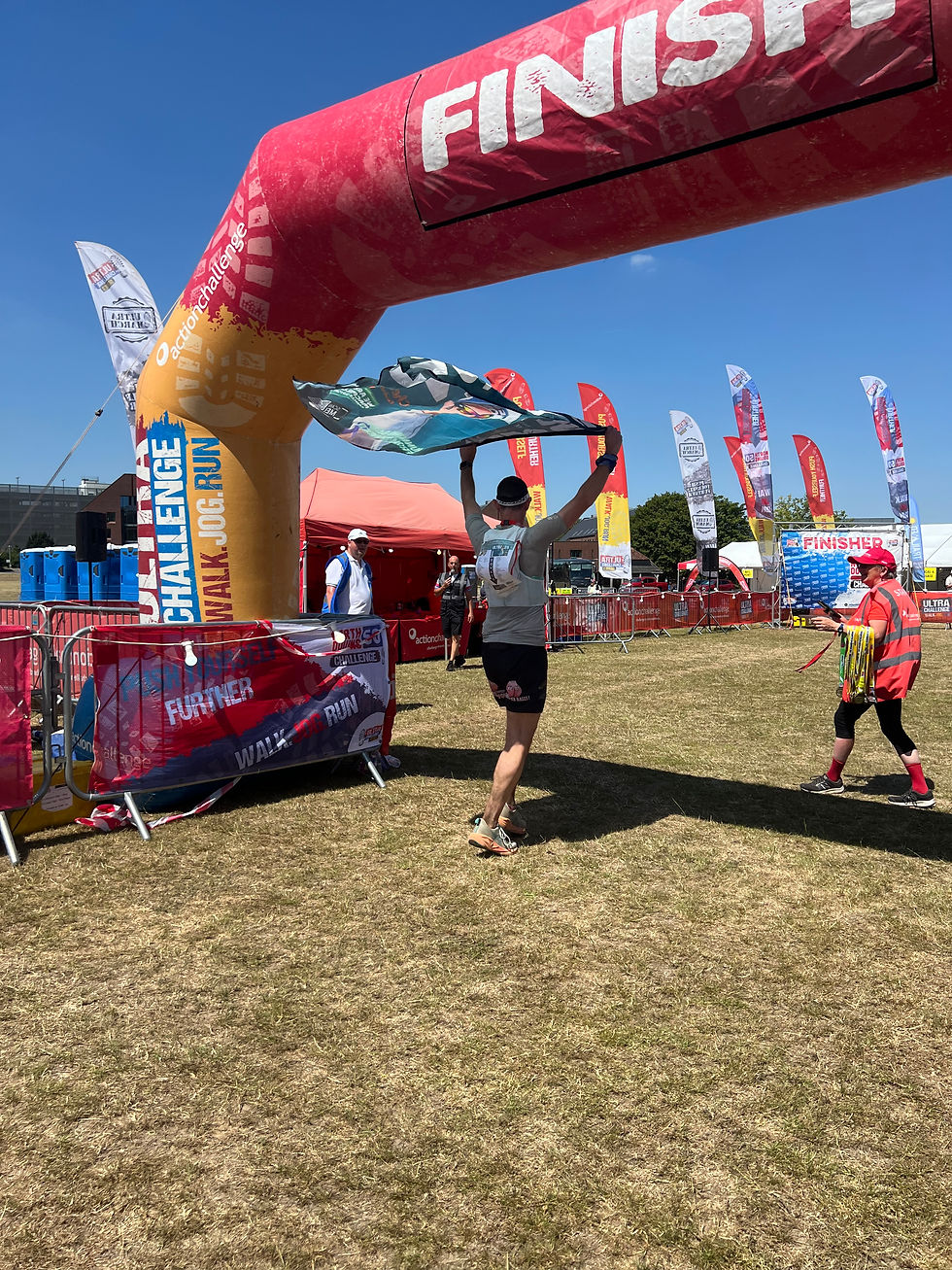
I ran it at the start of August, and, unseasonably for the UK, it was hot, around 30 degrees. Brutal at the time, but it came with a hidden benefit: it started acclimatising me for what was waiting later in the year at Nice. The course was overwhelmingly trail, as most ultras are, but light trail, nothing technical, no steep climbs. In fact the going was so benign that I ran the whole thing in road shoes, my Asics Novablast 5.
I don't race for time. I run as a cancer advocate, in shorts that proudly say I'm a cancer survivor and carry a message encouraging guys to check their testicles, so it's probably just as well I'm not chasing a clock, because I get stopped constantly for photos and conversations along the way. My training block for this, built in Runna, was set up around the specific terrain profile, and that's one of the real strengths of the app: it lets you dial in everything from flat to all-out, leg-busting hilly.
Just under six hours saw me at the finish, feeling strong and having run an excellent race I was genuinely well prepared for.
This is the kind of 50K a generic plan can prepare you for reasonably well. Steady aerobic mileage, a long run that creeps up week on week, a bit of strength work; follow the grid and you'll likely get round. But notice what already made the difference for me: a plan set up for this terrain, not terrain in general.
The mountain one: Nice Côte d'Azur by UTMB, 50K (2024)
Now the other end of the spectrum. The 2024 Nice 50K, officially Nice Côte d'Azur by UTMB, the Eze to Nice route, was 54km with close to 8,000ft of climbing. It starts up at the Col d'Eze, climbs to its high point at the Cime de Cabanelle at over 1,000m, drags you across pre-Alpine foothills and the Mont Leuze trails, and finally drops you onto the Promenade des Anglais. Same "50K" on the entry form. Vastly more vertical, a genuine mountain profile, Mediterranean heat, and a course that punishes anyone who trained on the flat.

It came just three months after the North Downs 50, and it was a remarkably different beast. The heat was relentless. Even at 6am, sitting at the start line in Eze waiting for the off, the air was already heavy and hot (and suddenly that scorching August day in Surrey felt like a gift rather than a curse). But it was the terrain that defined this one: brutal and extremely technical, with hand-over-hand climbing up near-sheer vertical rock face.
The Novablasts I'd happily worn round the North Downs would have been a liability here; for Nice I ran in Tecton X2s, with a deep lug for the grip and stability the rock and steep ground demanded. I finished in around nine hours, and given the course that was a good day out: same relaxed approach, still stopping to chat and take photos, but the mountain gave nothing away for free.
The difference that got me round was the training block. For Nice it was loaded with hill work at far greater intensity, and it was 100% necessary. It prepared me properly for what the course threw at me. This is the thing: Runna takes the thinking out of it. Set it up right from day one against the actual race, and the programme matches the course, then adapts to you as you move through the weeks, monitoring your progress and adjusting the sessions as it goes.
Here's the point. If I'd trained for Nice using a plan built for the North Downs (flat, light trail, road shoes), I'd have been in serious trouble: undercooked on climbing, with a body unready for hand-over-hand rock and relentless heat. And if I'd thrown that brutal Nice mountain block at the North Downs, I'd have spent months doing far more than the race ever asked of me. Even the heat that prepared me was partly luck, an unseasonably hot August day doing a job no UK-built template would have planned for.
The single most important variable in your training, the profile of your actual race, is the one thing a printed grid can't know.
Where one-size-fits-all plans hit their ceiling
A good printed plan does a lot right. But it can't see you, and it can't see your race. That's where the cracks show.
It doesn't know your starting fitness. A plan that opens at 30 miles a week is a gift to one runner and an injury waiting to happen for another.
It doesn't know your race. Flat and runnable, or 8,000ft of Alpine climbing? Cool autumn morning, or Mediterranean heat? The grid is identical either way, but your training shouldn't be.
It doesn't know your life. You'll get ill. Work will explode. You'll tweak an ankle and lose a week. A piece of paper can't reshuffle itself around real life; it just sits there making you feel guilty about the sessions you missed.
It can't adapt. And adaptation is the whole game in endurance training. The body responds to load, recovery, and progression that actually match where you are, not where a template assumed you'd be in week seven.
None of this makes printed plans bad. It makes them a starting point, fine for a predictable race when life is behaving. The trouble is that ultras are rarely predictable, and life never behaves.
What good 50K training actually adapts to
Whatever tool you use, smart training for a 50K bends around a handful of principles.
Your real starting point. Build from the mileage you're genuinely doing now, not a number on a template. Progress gradually; small, consistent increases beat heroic leaps every time.
Your race's terrain. Hilly race? Train the hills, and just as importantly train the descents, because downhill running wrecks quads that haven't practised it. Flat and fast? Get comfortable holding effort over time. Technical trail? Spend time on your feet on technical ground, and get the footwear right while you're at it.
Time on feet, not just distance. Ultras are measured in hours. Back-to-back long runs on tired legs teach your body to keep going when it's depleted, far more race-specific than one heroic long run.
Fuelling and kit, rehearsed. Practise eating and drinking on every long run until it's second nature. Test your shoes, your vest, your gels; never debut anything on race day.
Recovery and taper that respond to you. Down weeks when you need them, not just when the grid says so. A taper that leaves you fresh, not flat.
My honest recommendation: let the plan adapt to you
This is where I've landed after years of ultras across wildly different terrain, and it's what I'd genuinely recommend to anyone training for a first 50K: use a plan that adapts.
I use Runna, and the reason is simple: it does the one thing a printed grid never can. You tell it your race, your current fitness, your goal and how many days a week you can train, and it builds a plan around you. Miss a session because you were ill or buried at work? It reshuffles. Training for the rolling North Downs 50 versus the climbing of Nice? Genuinely different plans, not the same grid with a different title at the top.
That's the difference that matters. A printed plan assumes a runner who doesn't exist, the one who never gets ill, never travels, whose race matches the template exactly. An adaptive plan works with the runner you actually are, on the week you're actually having, for the race you've actually entered. (I've written more about how Runna compares to just tracking on Strava if you want the deeper dive.)
If you want to see it for yourself, you can try Runna free here. Plug in your 50K and watch it build something that fits. Or download the app and use free trial code ANDY2 for 2 weeks free premium access

A few last things before you commit
Pick your race first, then train for that race. Need ideas? Start with my guide to the best ultra marathons in the UK. Look hard at the elevation profile; it tells you more about your training than the distance does.
Build your aerobic base. Most of your running should be easy. If you're not already doing it, Zone 2 running is the foundation everything else sits on.
Know your effort, not just your pace. On hills and trails, pace lies. Work out your numbers here, then learn to run by feel.
Respect the process. The runners who arrive at a 50K start line prepared and enjoy the day have one thing in common: they didn't rush it. They built gradually, trained for their actual race, and treated the training as part of the adventure rather than a box to tick.
A 50K is one of the most rewarding things you'll ever do, your first real step into the ultra world. Train for the race in front of you, not a generic version of it, and you'll cross that line grinning.
Lace up, enjoy the miles, and I'll see you out on the trails.
— Andy

Frequently asked questions
How long does it take to train for a 50K?
For most runners with a solid base already in place, a dedicated 50K block runs around 12 to 20 weeks. If you're coming straight off a marathon you'll be at the shorter end; if you're building from a lower starting point, or targeting a serious mountain race, give yourself longer. The honest answer is that it depends on where you're starting and what race you're training for, which is exactly why an adaptive plan that sets the timeline around you beats a fixed grid.
Can you run a 50K without running a marathon first?
Yes, plenty of people make a 50K their first race beyond the half marathon. It isn't compulsory to have a marathon behind you. That said, having run a marathon or a long trail event makes the step up far more comfortable, because you already know what being on your feet for hours feels like. If a 50K is your first big one, just build your base patiently and respect the distance.
How long does it take to run a 50K?
There's no single answer, and that's the whole point. My two 50Ks landed almost three hours apart: just under six hours on the rolling North Downs 50, and around nine hours on the brutally technical, mountainous Nice course, despite both being the same nominal distance. Terrain, elevation, heat and how much you stop all matter enormously. A flat, runnable 50K might take a steady runner six to eight hours; a savage mountain 50K can take ten or more.
Is a 50K much harder than a marathon?
It's not simply "a marathon plus five miles." The extra distance is modest, but the demands are different: most 50Ks are on trails with hills and uneven ground, you're on your feet much longer, and you have to eat and drink on the move in a way road marathons rarely require. The effort is usually more relaxed than a marathon, but it lasts a lot longer, so endurance, fuelling and pacing matter more than flat-out speed.
What shoes should you wear for a 50K?
Entirely depends on the course, which is a neat illustration of why training and kit should match the race rather than a template. For the light, non-technical trail of the North Downs 50 I ran comfortably in road shoes (Asics Novablast 5). For the steep, technical rock of Nice I needed Tecton X2s with a deep lug for grip and stability. Look hard at your race's terrain, then choose shoes for that, and always test them on long training runs before race day.
About the author
Andy Hood is an ultra and endurance runner, Runna ambassador and testicular cancer survivor based in Devon. After cancer took him out of his running shoes in 2021, he rebuilt through endurance running, beginning with a 170-mile run along the South West Coast Path to Land's End, an ultra a day across five days. Since then he's run events around the world, from the rolling trails of the North Downs 50 and London2Brighton to the Tour du Mont Blanc and the mountains above Nice at UTMB.

Alongside the racing, Andy designs bold, attention-grabbing charity ultras (a 50K on a shopping-centre treadmill and his Krispy Kreme London runs among them) and has raised over £27,000 for cancer charities to date. He's a loud advocate for men's health, encouraging guys to check their testicles for the signs of testicular cancer, a message he carries on his shorts at every race and through his Check Ya Balls underwear range.
You can follow Andy's journey, read more of his training and race writing, and find his merch at runningwestwardho.co.uk, or say hello on Instagram.
Thinking about your first 50K? Try Runna free and let your plan adapt to your race, your fitness, and your life.
Comments