Runna's Adapt for Heat: Could Runna's Latest Feature Be Their Hottest? (And I Checked Its Maths)
Written and published August 2026 | Andy Hood, ultra and endurance runner, 25 years of running, Runna ambassador and cancer survivor
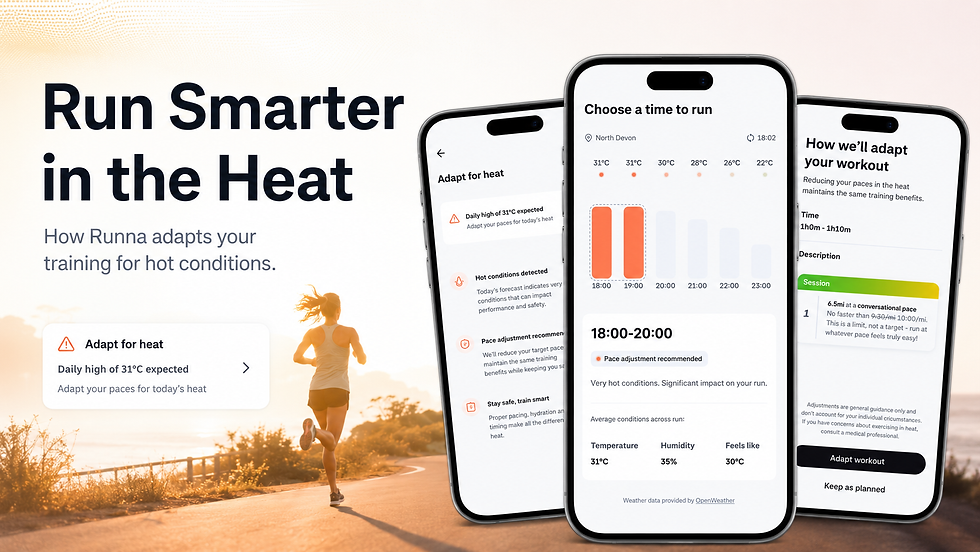
With the UK just about to enter its fifth heatwave of the year, there is no better moment for Runna to introduce heat adaptive training to the app.. I've had it on my phone through a proper hot spell in North Devon, I've run with its suggestions, and I've done something I don't think anybody else has bothered to do: I've checked its numbers against the published heat-pace research to see whether it's being sensible or soft. So what do I make of it, and are there any issues?
The short answer: Adapt for Heat reads the "feels like" temperature and the length of your session, shows you a colour coded hourly forecast so you can pick a cooler window, then suggests a slower pace you can accept or ignore. When I put its suggestion up against two established heat-pace models, Runna came out noticeably more cautious than both, by roughly seven to fourteen seconds a mile. That's a good instinct for a first version. It has one obvious blind spot, though, and it's a big one: the app has no idea what you are used to.
Readers of this blog can get a full 2 week Runna Premium free trial, double the usual, with code ANDY2.
🏃 Key takeaways
It's a prompt, not an autopilot. A lot of the press coverage called this automatic. It isn't. Runna suggests, you tap accept or keep as planned. Nothing changes on its own.
It ran more conservative than the textbooks. On my 30°C (86°F) evening run it asked for a 4.4% pace cut where the published models wanted 2 to 3.2%. Cautious, and on an easy run I'd argue that's the right way to be wrong.
It doesn't know your normal. A runner in Barnstaple and a runner in Lanzarote get the same advice at the same temperature. Runna admits this and says smarter thresholds are coming.
The data it's missing is data it already has. Runna can see your heart rate. It isn't using it. In-run adjustment based on what your body is actually doing is the obvious version two.
Beginners can't have it. It's excluded from the Foundational plans, which I find a curious call given who's most likely to cook themselves in a heatwave.
You're still the coach. No app knows you did legs at the gym last night or slept badly. Use it as a sanity check, not an instruction.
And none of this is a safety limit. These are performance numbers, not thresholds for how hard you can safely push. Knowing the warning signs of heat exhaustion matters more than any pace target.
Adapt for Heat at a glance
The question | The honest answer |
What does it actually change? | Your pace targets, and on some sessions the structure of the run itself |
What does it read? | "Feels like" temperature (temp, humidity and wind chill) plus how long your run is |
When does it appear? | The day before or on the day, roughly above 20°C (68°F) feels like |
Is it automatic? | No. You review a suggestion and accept it or decline it |
Where does the weather come from? | OpenWeather, using your phone's location |
Does accepting it hurt my plan? | No. Runna says progression, race estimate and mileage are unaffected |
Who can't use it? | Foundational plans, hills sessions, treadmill view |
Does it cover rain, wind or cold? | No. Heat and humidity only, outdoors only |
Is it heat acclimatisation? | No, and this trips people up. Different thing entirely |
Contents

Running in the heat changes everything
Running in the heat, especially when you're not used to it, changes so much about how you run. A tempo session or hill repeats at 30°C (86°F) is a completely different animal to the same session at 20°C (68°F). And for my US friends, I've put your numbers in brackets all the way through, so no mental arithmetic required.
The quick biology, because the rest of this article leans on it. When it's hot your body diverts blood to the skin to shed heat, which is blood no longer delivering oxygen to your working muscles. Your heart rate climbs, your effort rockets and your pace drops on a run that would have felt easy in cooler air. Humidity makes it worse, because sweat that can't evaporate isn't cooling you, it's just making you wet and cross.
I've written the full practical guide to this already, covering when to run, shade, kit colour, hydration and how to cool yourself on the move, in How to Run in Hot Weather: 10 Tips to Stay Cool and Safe. Read that alongside this one, because no app replaces the basics.
Living in the UK, my body is used to lower temperature running. And that's a clue. It's what you're used to that matters. What is your normal? Because here we'll see that the first iteration of Runna's heat adaptation isn't quite as smart as I think it will be in the future.
Apart from the unusual weather we've had at home, I have run in warmer countries. Lanzarote in 30 plus degrees (86°F and up), where the black volcanic ground makes it feel like running inside a fan oven. The Tour du Mont Blanc in 2023 when it hit 35°C (95°F) and a heat dome was parked over that corner of France. Even some of my UK runs have been properly hot: my 50K to Jeremy Clarkson's farm in 2025 was over 30°C (86°F), as was the Ultra Challenge North Downs 50 the same year. But the majority of my running each year is in lower temperatures, and that's what my body is conditioned to. Hold that thought, because it becomes the whole argument later on.

What Runna has actually launched
Runna announced Adapt for Heat at the end of July 2026, alongside two other features. Upcoming Plans lets you schedule several training blocks in advance so you can see a whole year in one go, and a revamped Post-Race Recovery Plan is created automatically when you start a 5K to 50K plan.

The stat they lead with is a good one, and I suspect most of you will recognise yourself in it. Runna's own research found that 80% of their community either adapt or skip runs because of hot weather. Strava data around June's heatwave said the same thing in a different way: pre-7am starts jumped sharply, running activity fell, and a chunk of people simply got on the bike instead.
One thing to clear up, because I've seen it muddled all over the internet. This is Adapt for Heat, not heat adaptation. Heat adaptation, or acclimatisation, is the physiological process your body goes through over roughly 10 to 14 days of consistent exposure: more blood plasma, earlier and more efficient sweating, a lower heart rate at the same pace. Runna's feature doesn't train any of that. It compensates for the conditions on the day. Two completely different things, and if you turn up expecting one and get the other you'll be disappointed.
Using it: my 6.5 miles at 31°C (88°F)
Open the app, click into the day's run, and you'll see an Adapt for Heat section sitting under the summary of what's expected.
As I write this I have a 6.5 mile easy run today, and the summary tells me it will be 31°C (88°F). Click into that and you're given a timeline with the estimated temperature for each hour. I'm planning a 6 to 7pm run, so I click 6pm and the bar chart tells me it will be 30°C (86°F) at that time. It reports that as very hot, humidity at 31%, and the impact on my run as significant.
There's a Review Suggestion button. Clicking that takes me to a screen where it suggests I adjust my pace from 9:30/mi to 9:55/mi max. I can accept that suggestion or keep to the planned workout. My choice.
That last bit matters more than the coverage let on. Nothing changes unless you tap accept, and if you run with a watch you need to resync afterwards or you'll be staring at your old paces halfway through. Garmin via Connect, Apple Watch by force-closing the app on the watch, COROS by pulling down on the training calendar.
Depending on the session and how hot it is, Runna can suggest slower pace targets on tempos and intervals, a slower conversational ceiling on easy runs, swapping a structured long run for an unstructured conversational one, or in genuinely extreme heat advising against running outside at all. Runna also says accepting an adaptation won't dent your plan progression or race time estimate, which quietly removes the temptation to be a hero for the sake of the algorithm. If you're new to how the plans themselves are built, I've covered that in Runna Training Plans Explained.
I checked Runna's maths against the research
Here's the bit nobody else has done, and the bit I was most curious about. Is 9:55 actually the right number, or has Runna plucked a comfortable-sounding figure out of the air?
Heat adjusted pace is not a new idea. Coaches and sports scientists have been doing it for decades, and there are two well-established ways to work one out.
The first is the coach's rule of thumb, popularised by Coach Mark Hadley at Maximum Performance Running. Add the temperature and the dew point together in Fahrenheit, look the total up in a band, and apply that percentage to your pace. It's a coaching heuristic rather than peer-reviewed science, but it's been used on real athletes for well over a decade, and crucially it uses dew point rather than humidity, because dew point is the honest measure of how much cooling your sweat can actually do.
And here's the detail I want you to notice, because it comes back to bite Runna later. Hadley gives every band as a range, and he's explicit about why: body size, fitness, physical make-up and, in his own words, the runner's level of acclimatisation. A blog chart from 2013 accounts for something the 2026 app doesn't. He also recommends halving the adjustment for short repeats like 400s and 800s, since you get some cooling in the recoveries. My session was a continuous easy run, so the full percentage applies.
The second is the research model, built on a 2022 paper by Konstantinos Mantzios and colleagues in Medicine & Science in Sports & Exercise. They pulled results from 1,258 races held between 1936 and 2019 across 42 countries, matched them to nearby weather station data, and analysed 7,867 athletes. Their finding: conditions of 7.5 to 15°C WBGT (45 to 59°F), which corresponds to roughly 10 to 17.5°C (50 to 63°F) air temperature, give you the best shot at peak performance, and for every degree of WBGT outside that band performance declined by 0.3 to 0.4%.
One thing to be clear about before we use it: that study looked at championship-level marathon and racewalking results. It's elite race data. Applying it to a Tuesday evening easy run in Devon is me borrowing a tool, not the authors making a recommendation.
So let's run my evening through both.
At 30°C (86°F) and 31% humidity, the dew point works out at about 11°C (52°F). Add that dew point to the 86°F air temperature and you get 138, which lands in the 131 to 140 band, calling for a 2 to 3% adjustment. On a 9:30 mile that's 9:41 to 9:47.
For the research model I had to estimate the WBGT, because you can't forecast it, you have to measure it. For an evening run in dry heat with the sun dropping, somewhere around 22 to 23°C (72 to 73°F) is a fair estimate, which puts me 7 to 8°C (13 to 14°F) above the optimal band and calls for roughly 2.1 to 3.2%. That's 9:42 to 9:48. Reassuringly close to the first method.
Method | Suggested pace | Adjustment on 9:30/mi |
Runna Adapt for Heat | 9:55 | +25 sec/mi (4.4%) |
Temperature + dew point rule | 9:41 to 9:47 | +11 to 17 sec/mi (2 to 3%) |
Mantzios-based research model | 9:42 to 9:48 | +12 to 18 sec/mi (2.1 to 3.2%) |
So Runna is asking me to run roughly seven to fourteen seconds a mile slower than either established model would. It's applying about one and a half times the adjustment the textbooks call for.
Now, before anyone declares Runna wrong, three pieces of honesty.
One: those models were built from race results, not training plans. They tell you how much a field of marathoners actually slowed down in the heat. That's a performance prediction, not a coaching prescription for a Tuesday evening easy run. Being more conservative than a race model on an easy run isn't an error, it's arguably the correct instinct.
Two: it was a dry day, and that flatters the rule of thumb. At 31% humidity, my dew point was low, and the dew point method rewards dry heat heavily. Push that same 30°C (86°F) up to 75% humidity and the dew point climbs to around 25°C (77°F), the total hits 163, and the rule of thumb suddenly demands 6 to 8%, which would be 10:04 to 10:16 per mile. That's a far bigger cut than Runna asked of me on a dry day. So the genuinely interesting question isn't whether Runna is too cautious in dry heat. It's whether it's cautious enough in muggy heat. I've not had a properly humid 30°C (86°F) day to test it on yet, and when I do, I'll report back honestly either way.
Three: my WBGT figure is an estimate. Proper WBGT needs a measurement including solar load and wind, not a phone forecast. Treat that row as indicative.
And one thing I want to say plainly, because I can see how this section could be misread. None of these numbers are safety limits. They are performance predictions, and they answer the question "how much slower will I be?", not "how hard can I safely push?". Finding that Runna is more cautious than a race model is not a licence to overrule it and run faster. If anything, on a hot training run, cautious is the correct direction to be wrong in.
What this tells me overall is that somebody at Runna has done the homework. The number isn't arbitrary and it isn't marketing. It sits in a defensible place, slightly to the safe side of the published work, which is exactly where a mass-market app aimed at people who aren't professional athletes ought to sit.
Runna Premium exclusive 2 week trial — click to redeem with code ANDY2
Where Runna gets its heat and humidity data
The weather data is provided by OpenWeather. Anyone who, like me, has about half a dozen weather apps on their phone and scrolls through them until they find the one telling them what they want to hear, will know that forecasts vary enormously. But we have to start somewhere, and picking a single source is probably the simplest way for Runna to go.
One practical tip. Give the app your precise location. Without it, the forecast may not reflect where you're actually running, and if you're on the coast or in a valley, as plenty of us in Devon are, that gap can be significant. The difference between the forecast for the nearest town and the reality on an exposed clifftop path is not small.

What Runna's Adapt for Heat doesn't take into account
Here's my main issue, and I've seen plenty of noise around this online too.
The pace suggestions are generic. It makes no difference whether I'm in the UK and conditioned to cooler running, or whether I live in Lanzarote and run in significantly hotter temperatures week in, week out. My normal, what my body is conditioned to, is very different to theirs, and the suggestions feel a little one box fits all.
This isn't a small quibble. An acclimatised runner can tolerate meaningfully higher heat loads than an unacclimatised one, which is precisely why the advice for anyone racing somewhere hot is to arrive early and let the body adjust. Ten to fourteen days of exposure genuinely changes what you can handle. An app that ignores that is treating two very different runners as the same runner.
To be fair to Runna, they acknowledge it. Their own support documentation says that runners in consistently warm climates may see suggestions more often than they need them, and that they're working on smarter thresholds that account for regular heat exposure. Good. That's the right fix, and it's honest of them to say so up front.
What would be really useful, and let's be honest, the data is already there, is adapting on the fly. Runna can see my heart rate. It could give me in-the-moment suggestions to change pace based on what it's actually seeing from my body, rather than what a forecast predicted the night before. Right now the feature works entirely from outside inputs: temperature, duration and session type. It has no idea what the heat is actually doing to me, which on the evening I described above is the only thing I genuinely cared about.
A few other limitations worth knowing before you go hunting for it in the app:
It isn't available on the Foundational plans, including New to Running, Return to Running and Path to parkrun. Those runners are pointed towards switching to effort-based training (RPE) instead. I find that a curious call. Newer runners are arguably the ones who most need a nudge to slow down, and the ones least equipped to judge it for themselves.
It skips hills sessions, because those are effort and time based and there are no pace targets to adjust.
It's outdoor only, and it covers heat and humidity alone. Nothing for cold, wind or rain.
Suggestions only appear the day before or on the day, and roughly once the feels like temperature is above 20°C (68°F).
But I'll say it again, for a first iteration it's good. It definitely has room for improvement.
The honest bit: what Adapt for Heat gets right and wrong
You know by now that I won't hand you a one-sided sales pitch, so here's where I've landed.
Genuinely good:
The numbers are defensible. It sits close to, and slightly safer than, the published heat-pace models.
The hourly forecast is the underrated part. Picking a better hour is a bigger win than shaving seconds off a pace, and this makes that decision a five-second job.
Removing the progression penalty is smart psychology. It takes the ego out of accepting a slower target.
Swapping a structured long run for a conversational one in high heat is exactly what a good coach would do.
Not so good:
No account of acclimatisation. The single biggest gap.
No use of live heart rate, despite the app already having it.
Excluded from the plans used by the least experienced runners.
Only as good as one weather provider's forecast for your postcode.
Heat and humidity only, so it's a summer tool rather than a conditions tool.
The bit no app can do: knowing when to stop
Everything above is about running slower. This part is about not running at all, and it matters more.
Heat exhaustion tends to announce itself gradually: heavy sweating, dizziness or light-headedness, a headache, nausea, cramps, clammy pale skin, and a heart rate that's much higher than the pace deserves. That's your cue to stop, get into shade, cool down and take fluids. Stop means stop, not "ease off and finish the loop".
Heat stroke is the serious one and it looks different. Confusion, slurred speech, behaving oddly, skin that's hot rather than clammy, sweating that shuts down, collapse. That is a medical emergency. Call 999, get the person into shade and cool them aggressively while you wait. It is not something to run off or sleep off.
Some people carry more risk than others, and that includes runners on medications that affect sweating, blood pressure or fluid balance, anyone with a heart condition, and anyone unwell or recently ill. If you're going through treatment for anything, or coming back from surgery as I have been this year, take the conservative option every single time. I have had runs this summer at 26°C (79°F) that were far harder than they should have been simply because I'd trained legs the night before and gone in tired. The forecast said nothing about that. My body said plenty.
None of this is in the app. None of it can be.
The bottom line on Runna's Adapt for Heat
Ultimately, you are responsible for your run. Forget the tech. Forget what a voice in your ear is telling you. You should be experienced enough to know when to adapt the run, when to slow down, or when to stop and take an extra rest. That is what being a runner is all about. If you blindly follow every piece of advice from an app, I'd gently suggest you still have a lot to learn about your running.
And note which way that cuts. Overruling the app to run slower, or to bin the session entirely, is always available to you and never the wrong call on a hot day. Overruling it to run faster is the one that needs a good reason.
But I'll give Runna its due here, and the maths is why. I went into this expecting to find a marketing feature with a comfortable number attached. What I found was a number that sits sensibly alongside decades of coaching practice and a large body of race data, tilted slightly towards caution. That's a good first version, and it's a better first version than I expected.
Where it falls short is that it doesn't know me. It doesn't know I've spent my winter running in single figures (roughly 40s°F), or that a Lanzarote local wouldn't blink at the day it just flagged as significant. Add acclimatisation and live heart rate and this stops being a clever forecast and starts being a coach.
For now, treat it as a well-informed second opinion. Which, on a 30°C (86°F) evening when your ego is telling you to hit the session as written, is worth having.
Try Runna free for 2 weeks with code ANDY2
If you want to test Adapt for Heat through the rest of this summer, I can offer readers of this blog a full 2 week Runna Premium free trial, double the standard offer.
Use code ANDY2, or click here to redeem your 2 week free trial.
Two weeks is long enough to run a proper training week, get through a heatwave, compare the app's suggestion against your own effort, and decide for yourself whether it earns its place on your phone. Come back and tell me in the comments whether you found it too cautious or about right, because I'd genuinely like to know how it behaves for those of you running somewhere hotter than North Devon.

FAQs: Runna's Adapt for Heat
What is Runna's Adapt for Heat?
It's a feature that suggests slower pace targets when it's hot or humid, based on the feels like temperature and the length of your run, plus a colour coded hourly forecast so you can pick a cooler time to head out.
Is Adapt for Heat automatic?
No, and a lot of the coverage got this wrong. Runna suggests the adjustment and you choose to accept it or keep the original session. If you run with a watch, resync it after accepting or you'll see the old paces.
At what temperature does Adapt for Heat kick in?
Roughly once the feels like temperature passes 20°C (68°F), though longer sessions trigger it at slightly lower temperatures, because heat accumulates over time.
Is Runna's heat adjustment accurate?
On my 30°C (86°F) test it asked for a 4.4% pace cut, where the temperature-plus-dew-point rule and the Mantzios research model both landed between 2 and 3.2%. So it's more conservative than both, by around seven to fourteen seconds a mile. Sensible for a training run, and worth knowing if you're using it to plan a race effort.
Does accepting a heat adaptation hurt my training progress?
Runna says no. Your plan progression, race time estimate and weekly mileage are unaffected.
Does it account for heat acclimatisation?
Not yet. You get the same suggestion whether you're used to running in 12°C (54°F) or 30°C (86°F). Runna has said it's working on smarter thresholds.
Why can't I see Adapt for Heat?
Most likely you're on a Foundational plan, it's a hills session, you're in treadmill view, it's more than a day before your run, or it simply isn't hot enough.
Does it cover cold, wind or rain?
No. Hot and humid weather only, and outdoor runs only.
Is Adapt for Heat the same as heat training?
No. This adjusts your pace for today's conditions. Heat acclimatisation is a physiological adaptation that takes 10 to 14 days of consistent exposure to build.
Run smart, respect the sun, and remember the app is a tool, not the boss of you.
Lace up and enjoy your miles.
About the author: Andy Hood

Andy Hood is an ultra and endurance runner, cancer survivor, and unapologetic advocate for men's health. He has raced from the half marathon up to multi-day mountain ultras, including the 160km Tour du Mont Blanc in 35°C (95°F), and trains regularly in the volcanic heat of Lanzarote. After a diagnosis tried to take his running shoes off, he laced them back up and turned the experience into a mission, designing bold ultras each year to raise awareness and funds, and founding his cheeky-but-serious menswear brand Check Ya Balls. Follow his runs, read his race reports and grab a pair at runningwestwardho.co.uk.
This article shares my personal experience with the app and publicly available research. The pace comparison uses published models applied to my own conditions and target pace, and individual responses to heat vary enormously. If it feels too hot to run, it's always okay to reschedule.
Article may include affiliate codes or links. I may receive a commission if you purchase products or services from any of the companies mentioned, at no cost to you. This goes towards running this blog, bringing you interesting articles and supporting my charity fundraising with over £27,000 raised to date.
Sources and further reading
Mantzios K, Ioannou LG, Panagiotaki Z, Ziaka S, Périard JD, Racinais S, Nybo L, Flouris AD. Effects of Weather Parameters on Endurance Running Performance: Discipline-specific Analysis of 1258 Races. Med Sci Sports Exerc, 2022;54(1):153-161. (7,867 athletes across 1,258 races; the basis of the modern heat-adjusted pace models.)
Hadley M. Temperature + Dew Point For Pace Adjustments. Maximum Performance Running. (The coaching chart, including his note that the ranges exist partly because of individual acclimatisation.)
NHS guidance on heat exhaustion and heatstroke, for the warning signs in the section above.
Runna support documentation: How Does Runna Adapt My Workouts for Heat and Humidity?
Runna press release, 29 July 2026, announcing Adapt for Heat, Upcoming Plans and Post-Race Recovery Plans.
Comments