How to Increase Your Running Cadence Safely (and the Truth About 180)
Updated: Aug 5
If you've been told to just "run at 180" and hit a wall, stick with me. Working on my running cadence genuinely helped me, but the story is a bit more honest than a single magic number, and there's a downside nobody seems to mention.
🏃 Key takeaways
A higher cadence can take the load off your knees and hips. For me that was the whole point. My joints were complaining on the long runs, and quicker, lighter steps quietly sorted it.
180 is a reference, not a target. It came from watching elite runners race. It's a handy sense-check if your cadence is very low, but it is not a magic cure, and it is not the number you must hit. I climbed to 180 and actively disliked it.
It shifts the stress, it doesn't remove it. The load comes off your knees and goes straight into your calves and Achilles. Rush it and you'll swap one problem for another. Ask my left Achilles.

Contents
Why I decided to work on my cadence
In late 2024 I decided to work on increasing my cadence. Why? Well that's pretty easy to answer, in fact I'll let my knees and hips answer that one for you: "we hurt".
I'm definitely not a natural runner. It takes thought and effort to improve my form, and moving into ultra and endurance distances has definitely shown up some weaknesses in the chain. When the miles stack up, the little inefficiencies you get away with over 10K start to send you the bill.
So I decided to check in on my cadence. More on how I did that, and how I still do it, a little later. It was shockingly low, around 150. There's a mythical number of 180 that gets bandied about, and I talk about that below, but for now it's worth saying that 180 isn't the figure you should be aiming for. It's not a magic cure. It is, however, a useful reference.
What is running cadence, in plain English?
Cadence is simply how many steps you take in a minute while you run, written as spm (steps per minute). Count every time either foot hits the floor for sixty seconds and that's your number.
Quick word on the jargon, because it trips people up. A step is one foot down to the next, left to right. A stride is a full cycle, left to right and back to left. Step rate is exactly double stride rate, which is why you'll see both "180" and "90" flying about describing the same thing. When runners talk cadence, they almost always mean steps per minute.
Here's why it matters. Your speed is your cadence multiplied by your stride length. Go for a longer stride and you often end up "overstriding", landing with your foot out in front of you and effectively braking with every step, firing all that impact up through the knees and hips. A quicker cadence naturally shortens the stride and brings your foot down closer to underneath you. That's where a lot of the benefit lives.
Where the mythical 180 steps per minute comes from
Right, the famous number. You'll hear 180 spm quoted as the "correct" cadence, the one every runner should chase. It isn't, and it's worth knowing where it came from before you go hunting for it.
Back in 1984, the coach and physiologist Jack Daniels sat and counted the cadence of elite runners at the Olympics. He found nearly all of them were running at 180 spm or higher. That's the whole origin story. An observation of professionals racing at the very front, not a lab study, and not a rule for the rest of us.
Two things got lost along the way. First, "180 or more" quietly became "180 exactly". Second, those athletes were racing, at paces most of us will never see. Cadence rises with speed, so fast running naturally produces a high cadence. Real elite runners actually range anywhere from about 160 to over 200 spm depending on pace, height and event.
So here's my honest take. Treat 180 as a rough reference point, nothing more. If you're miles below it, that's worth a look. If you're near it and feeling good, leave well alone. As you'll see, I got all the way to 180 myself and couldn't stand it.

Is increasing your cadence actually worth it?
Short answer: for me, yes, absolutely.
The hip and knee issues that used to nag me, especially on the long runs, have gone. That alone made the whole thing worthwhile. The gains showed up most on the road, and while the trails ask for something completely different, I still feel the work carried over into better form and efficiency across the board.
Why does it help the knees and hips? Back to that shorter stride. Quicker, lighter steps land your foot closer to underneath your body instead of reaching out in front, which softens the braking and the impact travelling up your legs. A lower cadence has been flagged as a risk factor for shin and knee trouble in some runners, and nudging it up tends to take load off those bigger joints. In plain terms: quicker feet, less hammering.
It's also one of the gentler form tweaks you can make. Overhauling your foot strike or your posture is hard and risky. Lifting your cadence a touch is a small, trainable change most runners get on with fine, as long as you respect the bit that comes next.
The downside nobody warns you about
Here's the caution, and it's the part most articles skate straight past. Increasing your cadence doesn't make the load disappear. It moves it.
Take the strain off your knees and hips and it has to go somewhere. It goes down the chain, into your calves and Achilles. I found this out over the weeks that followed. As I settled into a higher cadence I picked up tightness in my left calf, and my left Achilles especially, and both started to give me trouble.
It's completely predictable once you understand the mechanics, but it will catch you out if you don't. You can quite happily trade a grumpy knee for a grumpy Achilles, and an angry Achilles is not a small thing. It can hang around for months.
What got me through it was patience and management. A massage gun after every run helped the tightness, and, crucially, I was strict with myself about not pushing the cadence any higher for many weeks while my lower legs adapted. That discipline mattered more than anything else. The mistake nearly everyone makes is treating cadence like a dial you can crank up in a week. Your calves and Achilles need time to build the capacity for all those extra ground contacts.
If you've got a history of calf or Achilles trouble, read this section as a proper warning rather than a footnote. You'd be loading the exact tissue that's already vulnerable.
Who should work on cadence, and who shouldn't
Cadence work is a genuine fix for some runners and a waste of time, or worse, for others. Be honest with yourself about which you are.
Worth a look if:
Your cadence is genuinely low, say mid-150s or below, and you get recurring knee, hip or shin niggles, especially as the runs get longer.
You run mostly on roads. Flat, predictable ground lets you hold a steady rhythm, which is exactly what this needs.
You're stepping up in distance and feeling weak links appear, like I did heading into ultra territory.
Leave it, or tread carefully, if:
You have any history of calf, Achilles, heel or plantar trouble. Raising cadence pushes load straight onto those bits.
You're an experienced runner with no injury issues and a cadence that already feels comfortable. Your body has likely self-optimised over the years, and chasing a number risks breaking something that works.
You run mainly on trails. Ever-changing terrain, climbs and descents make a fixed cadence neither practical nor desirable.
The honest summary: cadence is a tool for a specific problem, not a free upgrade for everyone. Low cadence plus joint pain? Worth trying. Neither? Spend your energy elsewhere.
How to check your cadence
You don't need anything clever to start.
The low-tech way. On an easy run at your normal relaxed pace, set a timer for 30 seconds, count how many times your right foot lands, and multiply by four. There's your steps per minute.
The easy way. Most running watches and phone apps record cadence for you. Scroll back through a few recent easy runs and look at the average. Use easy runs rather than races or intervals, because cadence naturally climbs when you speed up. You want your everyday number, not your fastest.
Do it across a handful of runs to get a realistic baseline. Mine sat stubbornly around 150, which told me there was plenty to work with.
How I track my cadence (the app I swear by)
I promised I'd tell you how I track my cadence, because counting steps in your head mid-run will just leave you confused and exhausted. For this I am genuinely, and I mean genuinely, grateful for my good friends at Runna.
The post-run analysis lets you dive into a stack of metrics: pace, elevation, stride length, oscillation and, of course, cadence. Here's a graph from one of my recent runs. I'm just recovering from a major operation, so the cadence is a little lower than I'd like, but it's firmly on the cards to work on.

I dive into the cadence graph after most runs, looking at where it was good and where the improvements are to be made. And during the run, one of the screens on my watch (Apple Watch Ultra 3) shows a live cadence, which can be really useful in the early days when you're still learning the feel of it.
Runna builds form guidance into the app, through post run feedback in charts and data, and excellent videos from their coaching team, which you have access too on demand at any time.
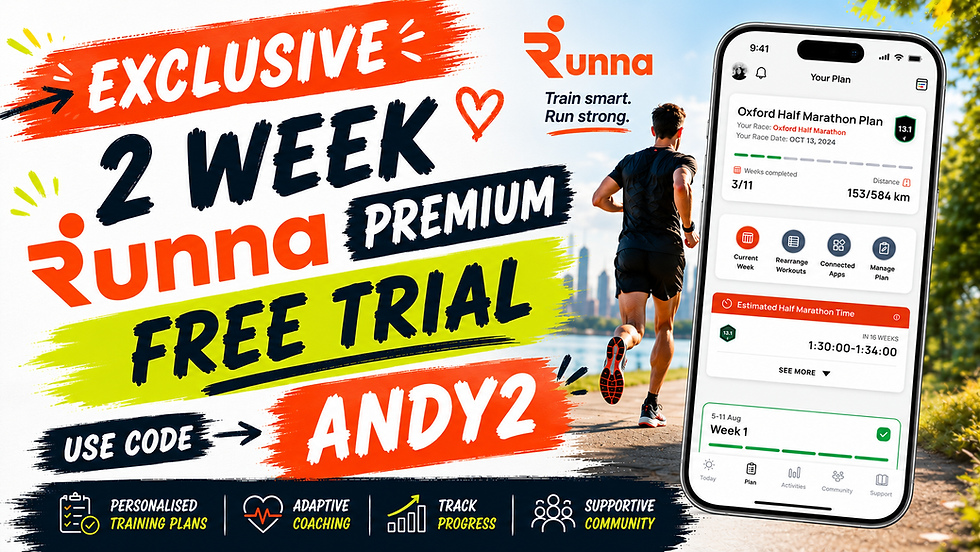
If you fancy trying the app, I've got an exclusive for you: a free trial that's double the usual one. A full two weeks of Runna Premium, every feature unlocked. Two weeks is enough to set up a personalised programme, run several sessions, and dig properly into the post-run metrics.
Grab it by downloading the app and using promo code ANDY2, or redeem it straight from this link: web.runna.com/redeem?code=ANDY2.
How to increase your running cadence, step by step
This is the method I used, and still use. The golden thread through all of it: go slowly, and never lift your cadence by more than 5 to 10% at a time.
1. Find your baseline and set a small target. Take your current number and add roughly 5%. From 150, that's about 158 to 160. Do not lunge for 180. A small, boring increase is exactly what keeps your calves and Achilles in one piece.
2. Run to a beat. This was the single best trick I found. I headed to Apple Music, downloaded a 160bpm album, loaded it onto my Apple Watch, and ran to that. Matching your foot strike to a steady beat takes the guesswork out entirely. It took a few minutes to dial into the beat, but once I did it was easy to keep in step. The catch is concentration. As the mind wanders on a run, as it always does, you drift off the beat, and you have to keep bringing your focus back to it. Prefer no music? A metronome app set to your target does the same job.
3. Remember it's not about running faster. This is the bit everyone gets wrong. Increasing cadence isn't about pace, it's about being lighter on your feet. Just because I was moving the cadence up didn't mean my pace was going to follow, and indeed it shouldn't, as easy runs should still be in your easy range. Think quick, light and quiet, feet landing underneath you. If your effort spikes, you've turned an easy run into a hard one and missed the point. By the end of that first run I was pretty much at 160, without running any harder.
4. Hold, adapt, and manage the new load. This is where patience earns its keep. I stayed at 160 for many weeks, deliberately not going higher, while my lower legs got used to the new stresses. As I said, the calf and Achilles tightness turned up here, and the massage gun after each run plus that strict ceiling saw me through. If your calves are shouting, that's your cue to hold, not to push on.
5. Only then, step up again. Once 160 felt genuinely comfortable, I climbed to 170, downloading a 170bpm album, and eventually to 180. Each jump followed the same rules: small increase, run to the beat, keep the pace easy, let the body adapt before moving on. And one honest note from my own experience: 180 was not comfortable for me. I couldn't find my groove and didn't enjoy running at that cadence at all. A good reminder that the "right" cadence is a personal thing. Higher isn't automatically better.

Where I've settled now
I didn't land on one magic number. I landed on a range that shifts with effort, which is exactly how it should be:
Run type | Where my cadence sits |
Easy runs | High 160s to low 170s |
Tempo runs | Mid 170s to 180s |
Speed intervals | Into the 190s |
Cadence naturally rises as you run faster, so chasing a single figure across every run never made sense. What mattered was lifting my everyday easy-run cadence off that shockingly low 150 and into a range that keeps my joints happy.
And the big caveat one last time: all of this is about road running. On the trails, with the terrain constantly changing, I run to feel, not to a beat. But the form and efficiency I built on the road came along for the ride, and the hip and knee pain that used to plague my long runs is gone.
Has it been worth working on cadence? Yes, definitely. Just do it slowly, and look after your calves.
Running cadence FAQs
What is a good running cadence?
There's no single correct number. Most runners sit somewhere between roughly 160 and 185 spm on easy runs, but it depends a lot on your height, pace and experience. Rather than aiming for a set figure, ask whether your cadence is unusually low and whether you're getting joint pain. If both are true, there's likely room to improve.
Is 180 steps per minute really the ideal cadence?
No. The number came from a 1984 observation of elite runners racing at the Olympics, most of whom ran at 180 spm or higher. It was never meant as a target for everyone. Treat it as a rough reference, not a goal. Plenty of runners are perfectly efficient well below it.
Will increasing my cadence make me faster?
Not directly. Raising cadence is about reducing impact and tidying up your form, not about speed. On easy runs your pace should stay the same while your steps get quicker and lighter. Any speed benefit tends to come indirectly, through better efficiency and fewer injuries keeping you training consistently.
How quickly should I increase my cadence?
Slowly. No more than 5 to 10% at a time, then hold there for several weeks before going higher. Rushing it overloads the calves and Achilles, which is the most common way people injure themselves trying to fix their form.
Why do my calves and Achilles hurt after raising my cadence?
Because a higher cadence shifts load off your knees and hips and down onto your lower legs. Some tightness while you adapt is normal. Persistent pain means you've gone too fast and should hold or ease back. Calf strengthening, a massage gun and patience all help.
Does higher cadence work for trail running?
Not in the same way. Trails throw constantly changing terrain, climbs and descents at you, so a fixed cadence isn't practical. Cadence training is most useful for road running, though the improved form does carry over onto the trails.
The bottom line
I went looking at my cadence because my knees and hips were fed up. What I found was real relief on the long runs, better form, and a bit more efficiency, all from quicker, lighter feet. But it cost me a couple of weeks of grumpy calves and a cranky Achilles to learn the lesson properly: go slowly, treat 180 as a reference rather than a rule, and listen to your lower legs.
Do that, and cadence might be one of the more worthwhile bits of form work you do this year.
About the author: Andy Hood
Andy Hood is an ultra and endurance runner, cancer survivor, and unapologetic advocate for men's health. After a diagnosis tried to take his running shoes off, he laced them back up and turned the experience into a mission: designing bold, attention-grabbing ultras each year to raise awareness and funds, particularly around testicular cancer.

That mission includes his cheeky-but-serious menswear brand, Check Ya Balls, kit with a message that quite literally saves lives.
His running CV runs from the 170-mile Running WestwardHo! to Land's End, to 160km around Mont Blanc, a self-designed 54K "Burger Run", a Krispy Kreme-fuelled London ultra, and, yes, 50K on a treadmill in a shopping centre. He's a proud Runna ambassador and has raised tens of thousands of pounds for cancer charities along the way.
Follow his runs, read his race reports, and grab a pair of Check Ya Balls at runningwestwardho.co.uk.
Lace up, enjoy your miles.
Article includes affiliate links/codes, I may receive a commission if you purchase products or services from the companies mentioned, at no cost to you. This goes towards running this blog, bringing you interesting and exclusive articles, and to support my cancer charity fundraising with over £27,000 raised to date.
Comments