The South West Coast Path: Britain's Greatest Trail — A Complete Guide for Walkers, Hikers and Trail Runners
Written by Andy Hood, ultra-marathon and endurance runner, cancer survivor, men's health advocate, founder of Check Ya Balls, and Runna Ambassador. Andy runs from North Devon, a handful of miles from the South West Coast Path, and has an intimate, hard-won relationship with this trail.
From Minehead to Poole, 630 miles of raw, extraordinary coastline. Whether you're planning a weekend section or dreaming of the full route, this is everything you need to know about England's most celebrated long-distance trail.
Table of Contents
What Is the South West Coast Path?
The South West Coast Path (SWCP) is England's longest established National Trail and one of the most iconic long-distance walking routes in the world. Stretching 630 miles (1,014 km) along the coastline of the southwest peninsula, it runs from Minehead in Somerset through the rugged coasts of Devon and Cornwall before turning east along the Dorset shore to finish at South Haven Point on the edge of Poole Harbour.
This is not a gentle amble. The path climbs and drops at virtually every river mouth and cove along the way, accumulating a total ascent of over 115,000 feet, that's roughly four times the height of Mount Everest, or the equivalent of climbing Snowdon 48 times. It has been voted Britain's Best Walking Route twice by readers of Walk, the Ramblers' magazine, and regularly features in lists of the world's greatest long-distance trails.
Put simply: the South West Coast Path is a national treasure.
Start and End Points
The official start of the South West Coast Path is Minehead in Somerset, where a large sculptural marker on the seafront marks the beginning of your adventure. From here the path travels anti-clockwise, through Exmoor, North Devon, across the entire coastline of Cornwall, along South Devon and the English Riviera, and finally east through the spectacular Jurassic Coast of Dorset to South Haven Point at Poole Harbour.
Most walkers and runners travel in this direction, Minehead to Poole, though the path can equally be walked or run in either direction. Commemorative markers are placed at Minehead (the start), Porthallow (the midpoint) and South Haven Point (the finish), and the route is waymarked throughout by the National Trail acorn symbol.
Who Manages the South West Coast Path?
The trail is managed as a National Trail, with Natural England overseeing its designation and maintenance alongside local highway authorities across Somerset, Devon, Cornwall and Dorset.
The South West Coast Path Association (SWCPA), a registered charity, is the dedicated body that champions and cares for the path on behalf of everyone who uses it. Founded in 1973, the SWCPA campaigns for improvements to the route, undertakes fundraising, and offers a wealth of resources including accommodation guides, completion certificates and the official annual guidebook (free with membership).
If you walk, hike or run the South West Coast Path and want to support its future, becoming a member of the SWCPA is one of the best things you can do.
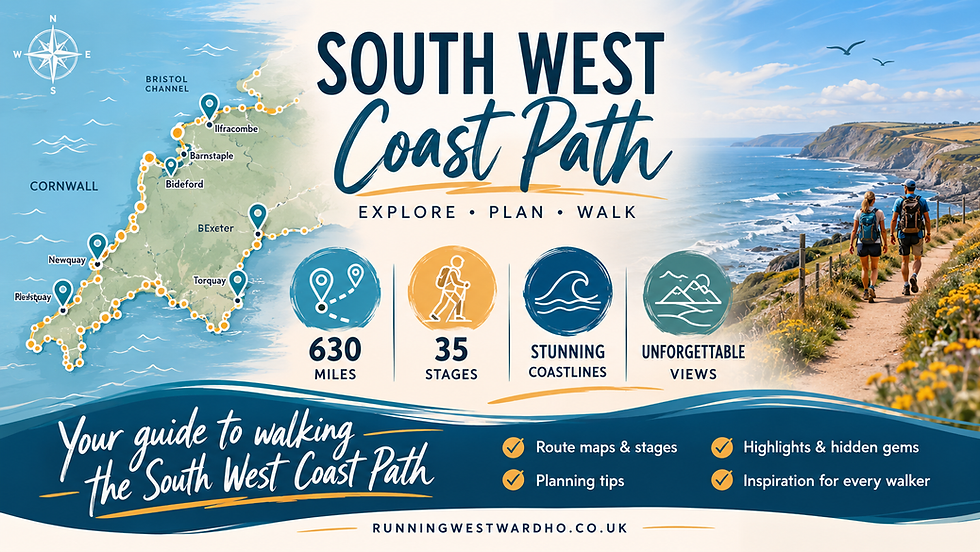
Distance, Difficulty and How Long Does It Take?
The full route is 630 miles (1,014 km) with over 115,000 feet of ascent and descent — making it far more demanding than the distance alone suggests. The terrain is unrelenting in places: steep valley descents, switchback cliff climbs, rocky scrambles, river crossings and sections of exposed headland that take no prisoners in bad weather.
For walkers and hikers planning the full route:
A fast walker can complete it in around 30 days
A comfortable, sightseeing pace typically takes 7 to 8 weeks (the official 52-day itinerary is a great starting framework)
Most people tackle it in sections spread over several years
The SWCPA divides the path into 52 sections, each representing roughly one day's walking. Difficulty ratings, easy, moderate, strenuous, or severe, are given for each section, though even the easiest sections have their moments.
Notable Places of Interest Along the Route
The South West Coast Path passes through some of the most beautiful and historically rich landscapes in England. Here are some of the highlights that make this trail utterly unforgettable.
Exmoor and North Devon The path opens on the dramatic cliffs of Exmoor before descending to the twin villages of Lynton and Lynmouth. The Valley of Rocks near Lynton is a wild, otherworldly landscape of jagged rock formations and roaming goats. Further along, Great Hangman near Combe Martin is the highest cliff on the entire trail at over 300m. Westward Ho!, the only place name in the United Kingdom to officially include an exclamation mark, sits on a long pebble ridge with a submerged prehistoric forest visible at low tide.
Clovelly One of the most photographed villages in England. Clovelly's famously steep cobbled street tumbles down to a small harbour, cars are banned, and donkeys have historically been used to carry supplies. Charles Dickens and Charles Kingsley both drew inspiration here. It's a place that genuinely stops you in your tracks.

Hartland Peninsula South of Hartland Point, the coastline transforms dramatically. Shaped by the full force of the Atlantic, the cliffs here are contorted, wave-battered and utterly spectacular. Waterfalls crash directly onto rocky beaches at Speke's Mill Mouth, and the remains of Iron Age hillforts and WWII military installations serve as reminders that this coast has always mattered. This is widely regarded as one of the toughest and most spectacular stretches of the entire path.
Tintagel Perched on the cliff edge of North Cornwall, the ruins of Tintagel Castle are steeped in Arthurian legend. The 13th-century castle and dramatic sea stacks create one of the most atmospheric views on the entire route.
Port Isaac The charming fishing village of Port Isaac, known to TV audiences as Port Wenn from Doc Martin, nestles in a steep valley on the North Cornish coast. Its narrow lanes, working harbour and fresh seafood make it a favourite stop for walkers and runners alike. Nathan Outlaw's celebrated seafood restaurant here is among the finest on the English coast.

The Cornish Mining Coast Between St Agnes and St Ives, the path passes through the Cornwall and West Devon Mining Landscape, a UNESCO World Heritage Site. The iconic engine houses of abandoned tin and copper mines rise from the clifftops like monuments, a striking reminder of the industrial heritage that powered Victorian England.
Land's End The symbolic end (or beginning) of mainland Britain. Whatever the weather, there's something deeply affecting about reaching Land's End, a headland jutting into the Atlantic where the next landfall west is North America. For trail runners especially, it carries enormous symbolic weight.
St Ives A former fishing town turned artistic hub, St Ives boasts world-class galleries (including Tate St Ives), golden beaches, and some of the clearest waters in England. A wonderful place to pause.
The Jurassic Coast The final stretch in Dorset follows the Jurassic Coast World Heritage Site, 95 miles of geology textbook brought to life. Durdle Door, Lulworth Cove, Chesil Beach, Golden Cap and the fossil-rich cliffs of Charmouth are all here. It's a fittingly dramatic finale to the trail.
The South West Coast Path for Trail Runners
Trail running the South West Coast Path has grown enormously in popularity over the past decade, and it's easy to understand why. The combination of technical terrain, dramatic scenery, constant elevation change and a sense of genuine adventure makes it one of the finest trail running environments in Britain.
The path can be tackled in sections of any length, from a two-hour evening run along a local headland to multi-day self-supported efforts covering 40 miles or more per day. Popular section runs include the North Cornish Coast from Bude to Padstow, the wild stretch from Hartland to Westward Ho!, and the Jurassic Coast between Lyme Regis and Swanage.
For those planning longer running efforts, the SWCP Facebook community is an excellent source of local knowledge, route updates and encouragement.
The Fastest Known Time (FKT)
The South West Coast Path has become a magnet for ultra-runners chasing its Fastest Known Time, and the record has been pushed to extraordinary levels.
The current record holder is Dan Lawson, who in July 2025 completed the full 630 miles in an astonishing 9 days, 13 hours and 40 minutes. In his own words, the effort left him not depleted but enriched, describing the path as speaking to him from the very first day, asking him to forget what he thought he knew about running and dance to its own unique rhythm.

Previous record holders include ultra-runner and author Damian Hall, who set a then-record of 10 days, 15 hours and 18 minutes in 2016, averaging around 60 miles per day. Hall was later beaten by Kristian Morgan, a London-based ultra-runner and coach, who completed the route in 10 days, 12 hours and 6 minutes in September 2020, running day and night, battling an unexpected heatwave, and breaking down in tears when a group of fishermen singing in a front garden moved him unexpectedly.
The women's record currently stands at 14 days, 14 hours and 44 minutes, set by Julie Gardener in 2013.
These times represent some of the most impressive feats of human endurance on any trail in the world.
The Salt Path — A Brief Word on the Book, the Film, and the Controversy

No article about the South West Coast Path in recent years would be complete without mentioning The Salt Path by Raynor Winn, the memoir that introduced millions of readers to the SWCP and became a publishing phenomenon.
The book tells the story of Raynor and her husband Moth, who, facing homelessness and Moth's diagnosis with a progressive neurological condition, walk the full 630 miles of the South West Coast Path. It became a Sunday Times bestseller, was shortlisted for the Costa Book Awards and the Wainwright Prize, and was adapted into a film starring Gillian Anderson and Jason Isaacs.
In 2025, however, the book became the subject of significant controversy. An investigation published in The Observer raised allegations that aspects of the story had been misrepresented, including the circumstances under which the couple lost their home and questions about the accuracy of Moth's diagnosis as portrayed in the book. A documentary, The Salt Path Scandal, aired on Sky Documentaries in December 2025. Penguin placed Winn's fourth book on hold as a result.
The controversy has divided readers and the literary world. Whatever one concludes about the book's accuracy, the South West Coast Path itself, the muddy reality of it, the aching legs, the salt-stung faces, the sunsets over the Atlantic, remains entirely, undeniably real. And that is what endures.
Running Westward Ho! — A Personal Story
The South West Coast Path carries different meaning for everyone who walks or runs it. Here, our writer shares his own story.
I have a long history with the South West Coast Path, living just a handful of miles from it in North Devon. Trail running brings with it a new perspective on this place, you connect more closely with the landscape, its contours, the hundred-year-old trees, dramatic views and the rivers that have flowed for thousands of years carrying so much history with them. Then there are the signs of industry and conflict: the mines on the North Cornish coast and their picturesque engine houses, the Iron Age hillforts, the World War II bunkers. You get to slice through history in a way that road running simply doesn't give you.
The path carries deep personal meaning for me. In 2021 I was planning a run from Westward Ho!, the only place in the United Kingdom to officially have an exclamation mark in its name, to Land's End, a place of symbolic meaning to so many. The run would cover 170 miles of arguably the most beautiful sections of the SWCP: Clovelly, Hartland, Port Isaac and St Ives, to name just a few of the coastal communities I'd leave my footprints in.
The run was conceived after I saw my Mum affected by the loss of her last sibling. Claire had been in a care home for several years, diagnosed with dementia, COVID would sadly take her. It hit Mum hard. I decided to do something equally hard: run to Land's End, raising money for an Alzheimer's charity along the way.
I'd never get to start that run in 2021. Cancer would take me out of my running shoes.
And that's where life pivoted. Cancer would have me rebuilding my life, my perspective and my running. I'd return to the coast path in late 2022 to take on the 170-mile run. The meaning of the run had changed. I'd still run for the original reason, my Mum and her loss, but now there was new meaning: my own recovery from cancer.

The run is worthy of a book in itself. The journey I went on, physically and mentally. The people I met along the way. The conversations, some very deep and meaningful. I posted before and during the run in the South West Coast Path Facebook group, which got great engagement and support. It meant that people walking or hiking the path were tracking me, and I'd often round a corner or drop into a small village to cheers, or calls of "there he is!"
In brief: the South West Coast Path feels like home. I'm often running sections of it and plan to run my Westward Ho! to Land's End route again before long. That 2022 run gave its name to my Instagram account and to this website. Setting off from Westward Ho! after the cancer operation and chemotherapy, running westward, I imagined myself bellowing "Westward ho arrrh!" in my best pirate voice as I ran.
And so runningwestwardho was born.
Perhaps I'll write about it all one day, a book that holds a lot of emotion and just a little more truth than The Salt Path.

Essential Resources for Planning Your South West Coast Path Adventure
Whether you're planning a single day section or the full 630-mile route, these are the best resources to help you get started:
Official Resources
Guidebooks
Apps and Navigation
Community
🔗 South West Coast Path Facebook Group — an excellent community for advice, inspiration and real-time conditions reports
Trail Running Specific
Frequently Asked Questions
How long is the South West Coast Path? The South West Coast Path is 630 miles (1,014 km) long, making it England's longest established National Trail. It runs from Minehead in Somerset to South Haven Point at Poole Harbour in Dorset, passing through Devon and the entire coastline of Cornwall along the way.
Where does the South West Coast Path start and finish? The official start is at Minehead in Somerset, marked by a large sculptural waymarker on the seafront. The path finishes at South Haven Point on the edge of Poole Harbour in Dorset. Most people walk or run anti-clockwise, Minehead to Poole, though either direction is perfectly valid.
How long does it take to walk the South West Coast Path? It depends entirely on your pace. A fast walker can complete the full route in around 30 days. A comfortable, sightseeing pace typically takes 7 to 8 weeks. The South West Coast Path Association publishes an official 52-day itinerary as a useful planning framework. Most people complete the path in sections spread over several years rather than in one continuous journey.
Is the South West Coast Path difficult? It is genuinely challenging. The total ascent over the full route exceeds 115,000 feet, roughly four times the height of Mount Everest, because the path rises and descends at virtually every river mouth and cove. Some sections are rated easy, others severe. First-time walkers are advised not to overestimate daily mileage, particularly on the exposed stretches of North Devon and North Cornwall where the terrain can be relentless.
Can you run the South West Coast Path? Absolutely, trail running the SWCP has grown enormously in popularity. The path offers some of the finest trail running terrain in Britain: technical, varied, constantly scenic, and rich with history. Runners tackle it in sections of any length, from a short evening run to multi-day self-supported efforts. The current Fastest Known Time for running the full 630 miles is 9 days, 13 hours and 40 minutes, set by Dan Lawson in July 2025.
What is the Fastest Known Time for running the South West Coast Path? The current outright FKT is held by Dan Lawson, who completed the full 630-mile route in 9 days, 13 hours and 40 minutes in July 2025. Previous record holders include Kristian Morgan (10 days, 12 hours and 6 minutes, 2020) and ultra-runner Damian Hall (10 days, 15 hours and 18 minutes, 2016). The women's record stands at 14 days, 14 hours and 44 minutes, set by Julie Gardener in 2013.
Who manages and maintains the South West Coast Path? The path is designated as a National Trail, overseen by Natural England in partnership with local highway authorities across Somerset, Devon, Cornwall and Dorset. The South West Coast Path Association (SWCPA) is the registered charity that champions the path, campaigns for improvements, and provides resources for walkers, hikers and runners. Becoming an SWCPA member is one of the best ways to support the trail's future.
Do I need a permit to walk the South West Coast Path? No permit is required. The South West Coast Path is a public right of way and a National Trail, freely accessible to everyone. It is waymarked throughout with the National Trail acorn symbol. Certain sections may be temporarily closed due to landslips or erosion, always check the SWCPA website for current diversions before setting out.
What are the best sections of the South West Coast Path for beginners? The Jurassic Coast in Dorset offers some of the most accessible and rewarding walking, with well-maintained paths and spectacular geology. The South Devon coast between Dartmouth and Salcombe is another popular choice, beautiful, manageable and well-served by accommodation. For a taste of the path's drama without the most extreme terrain, the stretch between Padstow and Newquay on the North Cornish coast is excellent. Beginners should start with shorter sections rated easy or moderate on the official itinerary.
What is The Salt Path and what was the controversy? The Salt Path is a memoir by Raynor Winn, published in 2018, which tells the story of her and her husband walking the full 630 miles of the SWCP after becoming homeless. It became a major bestseller and was adapted into a 2025 film starring Gillian Anderson and Jason Isaacs. In 2025, an investigation by The Observer raised questions about the accuracy of certain events described in the book. A documentary, The Salt Path Scandal, aired on Sky Documentaries in December 2025. The path itself remains as magnificent and demanding as ever.
What is the best time of year to walk the South West Coast Path? Late spring (May–June) and early autumn (September–October) are generally the best times, good weather, longer days, and fewer crowds than the peak summer months. Summer is busy around popular spots like St Ives and Padstow. Winter walking is possible but requires careful planning, though a wild winter day on the cliffs of Hartland or Exmoor is an experience like no other.
What should I wear and carry on the South West Coast Path? Good waterproofs and sturdy, broken-in footwear are essential regardless of the season, weather on exposed clifftops can change quickly. For day sections, a small rucksack with water, snacks, a map or downloaded GPX route, a fully charged phone, and a basic first aid kit covers most scenarios. Longer multi-day walkers should plan accommodation in advance, particularly in summer. Trail runners should pack layers, nutrition, and be aware that mobile signal can be patchy in valleys and on remote headlands.
About the Author
Andy Hood is an ultra-marathon and endurance runner based in North Devon, just a few miles from the South West Coast Path. A testicular cancer survivor, Andy has channelled his recovery into a mission to inspire others, through bold running challenges, fundraising, and honest conversations about men's health.
To date he has raised close to £30,000 for cancer charities, including through self-designed ultras that have taken him across London, through the Alps on the Tour du Mont Blanc, and along the very coast path described in this article. He is the founder of Check Ya Balls, a men's underwear brand with a serious message about self-checking for testicular cancer, and is proud to be a Runna Ambassador.
You can follow Andy's running journey, read his blog, and explore his upcoming fundraising runs at runningwestwardho.co.uk. If Andy's story has connected with you, whether through running, cancer, or just a love of the South West Coast Path, he'd love to hear from you.
Running Westward Ho! is written from North Devon, close to the South West Coast Path. Follow the journey on Instagram @runningwestwardho.
Comments